
Together with Amandla.mobi, Tekano will host a panel discussion at the Human Rights Festival on 28 March 2026 at 15:00 in the Dignity Room at Constitutional Hill. The discussion is titled Technology, Power, and Democracy in South Africa: Reclaiming the Digital Commons. This session examines how South Africa’s digital public sphere is being shaped by private platforms, global technology corporations, and state choices that increasingly rely on proprietary systems to deliver public services.
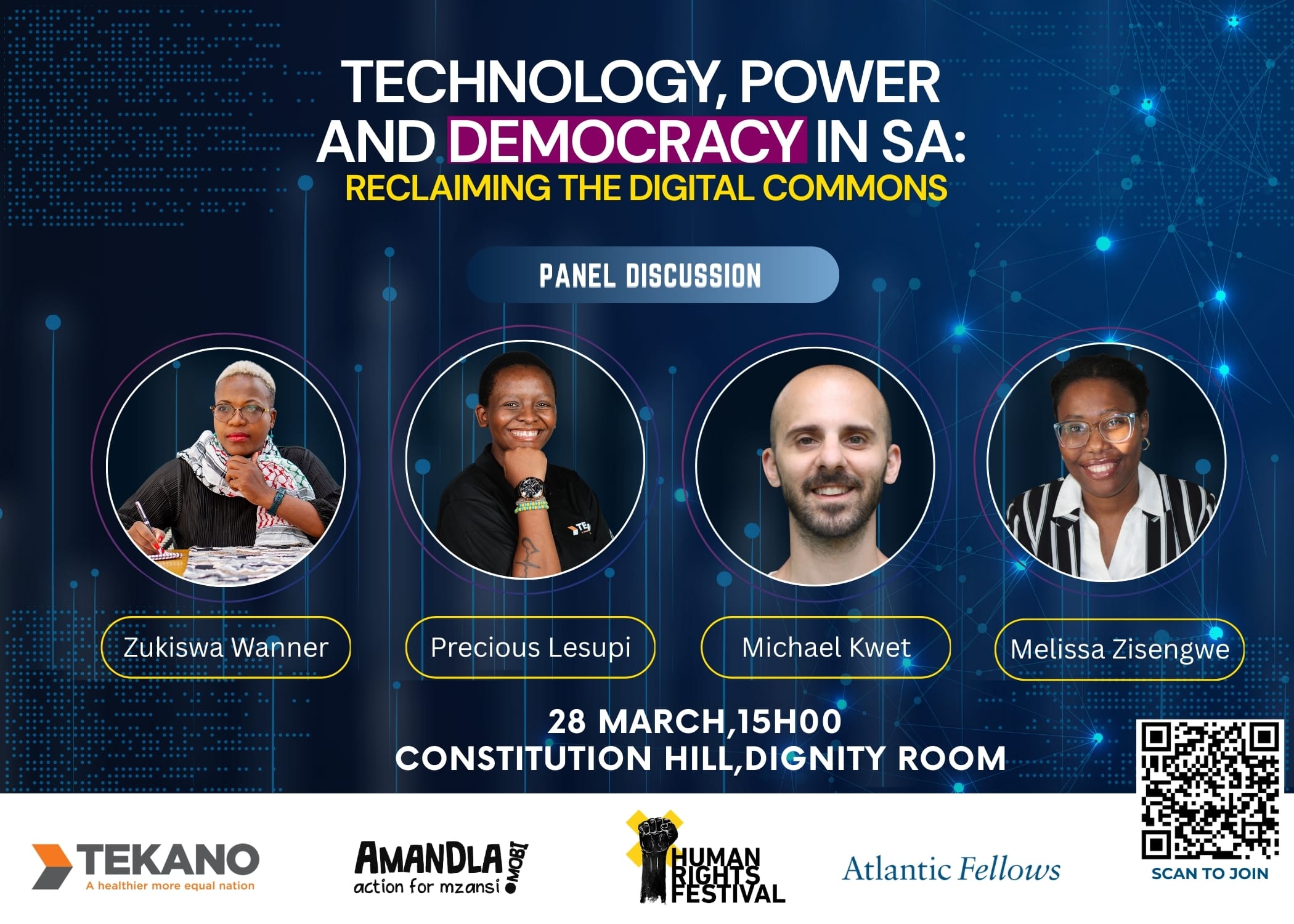
Rather than treating technology as neutral or inevitable, the discussion asks how power is exercised through digital platforms, infrastructures, and governance arrangements, and what this means for democracy and public accountability. Framed between digital sovereignty and digital colonialism, the panel explores how data extraction, high data costs, algorithmic decision-making, surveillance technologies, and global trade rules can deepen inequality and exclusion. Particular attention is given to how digital systems silence and target marginalised voices, including women, trans, and gender-diverse people, as well as working-class and rural communities, through online violence, economic barriers, and opaque technological control. Moving beyond narrow debates about access or innovation, the session asks what it would take to reclaim digital spaces and systems as part of the democratic commons.
Meet the Panellist
Zukiswa Wanner is the author of five novels, which include the award-winning London Cape Town Joburg, which was adapted for stage and performed at the National Arts Festival in Makhanda. In addition to novels, Ms. Wanner has authored four children's books, a travel memoir, a satirical nonfiction and a long-form essay on Palestine, Vignettes of a People in an Apartheid State. She has translated the children's anthology Story Story Story Come from English to Shona and her own writing has been translated into Portuguese, French, Spanish, Kiswahili, Russian, German, Shona and Arabic. In 2020, she became the first African woman to be awarded the Goethe Medal for her contribution to culture by the German government alongside Bolivian artist Elvira Espejo Ayca and British writer Ian McEwan. Ms. Wanner returned that award to the German government in 2024, protesting their complicity in the ongoing Palestinian genocide and their silencing of pro-Palestinian artistic voices. She has twice been selected by the pan- African publication New African among 100 Most Influential Africans - in 2020 in the Arts category and in 2025 among Thinkers and Opinion Shapers. Her latest works are Flotilla: A Journey of Conscience, her personal account of the Global Sumud Flotilla's attempt to break the Gazan siege in 2025 and Sunshine City, a translation of Pauline Chirata- Mukondiwa's Shona novel, Zvinobvinza. Since 2015, Ms. Wanner has been on the Advisory Board of Ake Festival in Nigeria and has facilitated panels annually when in attendance. She recently guest-presented on talk radio Salaamedia.
Precious Mamotingoe Lesupi is a senior data security engineer and founder of Queers Code. Their passion lies heavily in building and advocating for inclusive and accessible technology for minority groups. They graduated with a BA Journalism and French degree from the UFS, BA Hons Visual Studies from UP, and are currently pursuing their Master’s in Visual Studies at UP. They have independently written and published an academic Mathematics research paper on African Fractal Geometry and String Theory, which they have also presented at the annual South African Mathematics Society Conference. Due to their innovative engineering of a drone - with a built-in automated flight safety system inclusive to the digitally unsavvy - that detects traffic violations, and is set up to be sent on specific missions thereafter, they have become a BRICS+ International Unmanned Aircraft Systems (UAS) expert and Digital Industry expert contributing on the UAV and Automation competition committee. In their quest to advocate for inclusive and accessible tech, Precious also contributes to several international initiatives, including the BRICS Business Council and UN Human Rights Defenders. While continuing to pioneer innovation towards inclusivity and accessibility, they provide masterclasses, train mentors, provide mentorship, and are always contributing to academic research in inclusivity and accessibility in the STEAM field.
Michael Kwet is a Senior Researcher of the Centre for Social Change at the University of Johannesburg. A pioneering scholar at the forefront of digital colonialism, Michael is editor of The Cambridge Handbook of Race and Surveillance (2023), author of Digital Degrowth: Technology in the Age of Survival (Pluto, 2024), and founder of the forthcoming website, PeoplesTech.org. He has also published at outlets like Al Jazeera, The Intercept, Mail & Guardian, Counterpunch and Truthdig. Michael received his PhD in Sociology from Rhodes University, South Africa.
Melissa (Mel) Zisengwe, Programme Manager, Cape Town, South Africa (via Zimbabwe). Melissa manages the development and implementation of People Powered’s capacitybuilding programs. Mel is responsible for planning, designing, and managing accelerator programs’ content and activities, as well as integrating People Powered’s resources, tools, and materials into these programs. Her work focuses on programs and activities that help and empower governments and organizations globally adopt more equitable and inclusive participatory democracy programmes. Mel draws on her background and expertise in digital democracy and civic tech to help governments and organizations adopt and improve their digital participation ecorts. Before joining People Powered, Melissa worked as a program ocicer for the Civic Tech Innovation Network (CTIN), a network that brings together the African civic tech community. She has also worked as a program assistant and collaborations coordinator for Code for All, and as a research fellow at the Collaboration on International ICT Policy for East and Southern Africa (CIPESA). Melissa holds a bachelor’s degree in journalism and linguistics from Rhodes University and a master’s degree in tech policy and regulation from the University of the Witwatersrand. Outside of her work, Melissa enjoys swimming, dancing (Bachata), learning new languages, and reading.
Recent Comments