
In critically engaging capitalism, I find it necessary to move beyond viewing it as a purely economic system and instead understand it as a historically embedded structure of power. Capitalism is not detached from politics or history; it is deeply entangled with colonialism, racialisation, and ongoing forms of exclusion. In the South African context, its present configuration cannot be separated from apartheid’s spatial, economic, and social legacies, which continue to shape inequality in profound ways.
Drawing on Karl Marx, capitalism can be understood as a system rooted in exploitation, particularly through the extraction of surplus value from labour. However, while Marx offers a powerful critique of class relations, his framework does not fully account for the racialised and colonial dimensions that have defined capitalism in the Global South. This is where decolonial thinkers become essential.
Frantz Fanon extends this critique by exposing how colonialism produces not only material dispossession but also psychological and epistemic domination. For Fanon, the colonised are not merely economically exploited; they are systematically dehumanised, with their identities reshaped through violence and exclusion. This insight is critical in understanding contemporary inequalities, where economic marginalisation is inseparable from historical processes of racial and colonial subjugation.
ALSO READ:
Decolonial theory further deepens this analysis by challenging the universality of Western knowledge systems and economic models. It calls for the recognition of alternative ways of knowing, being, and organising society, many of which have been suppressed under colonial rule. From this perspective, rethinking capitalism is not simply about reforming markets; it is about dismantling the epistemic and structural foundations that sustain inequality.
Within justice-oriented frameworks such as those advanced by Tekano Health Equity, the urgency of this rethinking becomes even clearer. Inequality is not only an economic issue but also a health, social, and moral issue. The unequal distribution of resources directly translates into unequal life chances, where the most marginalised communities continue to experience the highest burdens of disease, poverty, and exclusion.
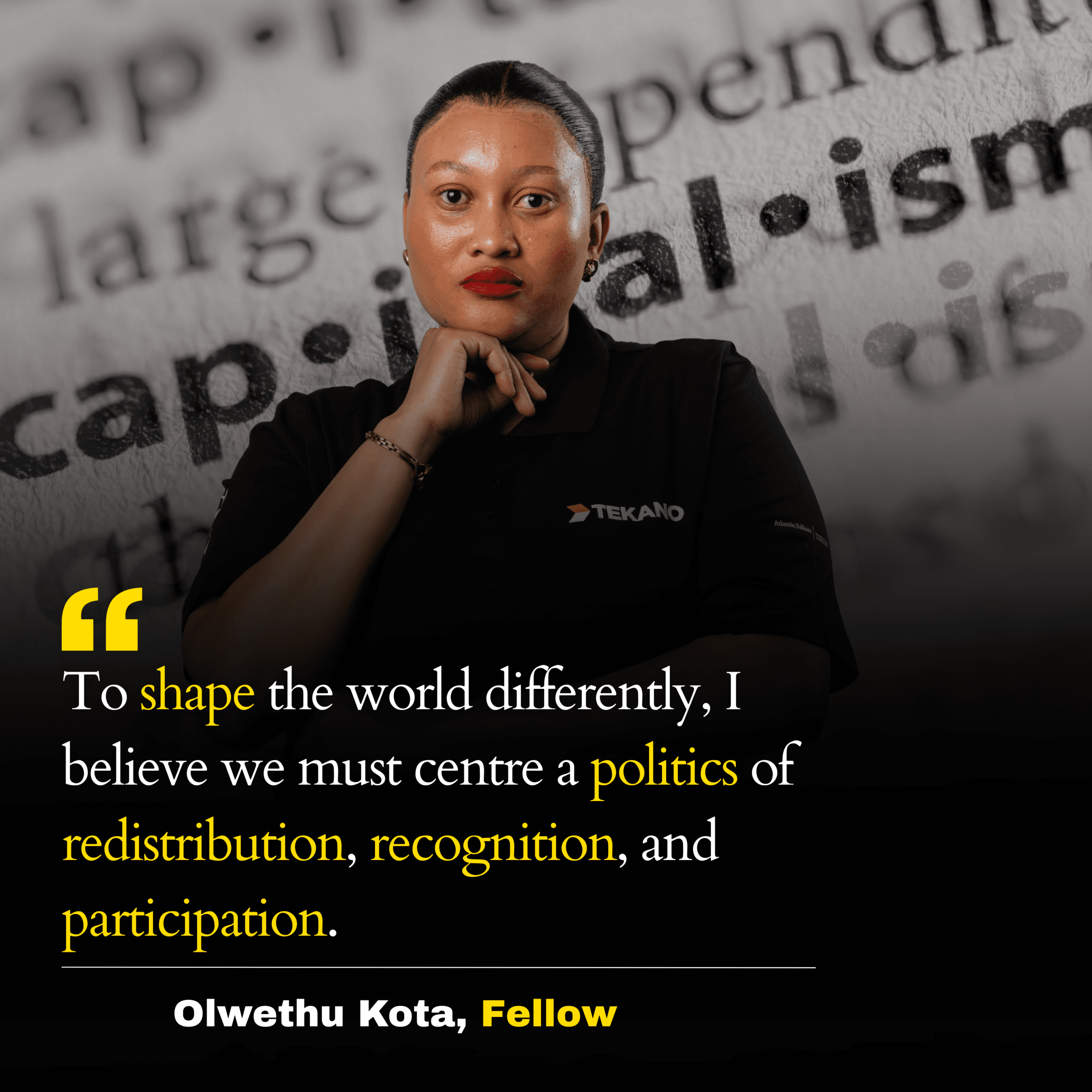
To shape the world differently, I believe we must centre a politics of redistribution, recognition, and participation. Redistribution speaks to the material reallocation of resources and opportunities. Recognition requires affirming the dignity, knowledge, and lived experiences of those who have been historically marginalised. Participation demands that communities are not passive recipients of development but active agents in shaping their futures.
Importantly, this transformation is not only theoretical, but it is already visible in community-based practices of solidarity, care, and resistance. In many contexts, including those I engage with, people are creating alternative economies rooted in mutual support, collective ownership, and social justice. These initiatives challenge the dominant logic of individual accumulation and instead prioritise communal well-being.
ALSO READ: When Healthcare Excludes
As a community-based activist, I locate myself within this space of both critique and action. My work is not only to analyse systems of power but also to contribute to their transformation. This requires aligning research with activism, amplifying marginalised voices, and engaging in forms of knowledge production that are accountable to the communities they serve.
Ultimately, rethinking capitalism through a decolonial lens is about more than economic reform; it is about reimagining the very foundations of our social world. It is about building a future where systems are designed around justice, dignity, and collective flourishing. In this sense, shaping the world becomes a deeply political and ethical project, one that demands not only critical reflection but also sustained and intentional action.
By Olwethu Kota, an advocate for children’s rights and health equity
Recent Comments